The World Health Organization (WHO) is a specialized agency of the United Nations, concerned with coordinating responses to international public health issues and emergencies. It is referenced in promotional material released for Fear the Walking Dead.
Outbreak
On 15 April 2010, the Center for Disease Control discovered a new, small and unknown virus. In the following months, the virus has been reported to the World Health Organization in the list of "possible catastrophic contagions", a comprehensive list of all pathogens that developed significant characteristics which are able to be transmitted to human and create a catastrophe of global proportions. WHO research teams failed to determine if the virus was human made or artificial; squads at la Biomédicine / DDMI managed to hide the evidence of their involvement, which later emerged as France was the only one that knew how to slow down the contagion.
The World Health Organization, along with the CDC, declared a global pandemic on August 25, 2010.
Early in the outbreak, WHO released a six-page memo (only the first page of which is seen) to all medical staff concerning the recently deceased. This implies that the outbreak, while not well-known by the general public, was considered serious enough to be discussed at an international level. The directives it sets forth can be seen in operation at the Temple Community Hospital where Nicholas Clark is treated after his accident. Some of the directives to medical staff include:
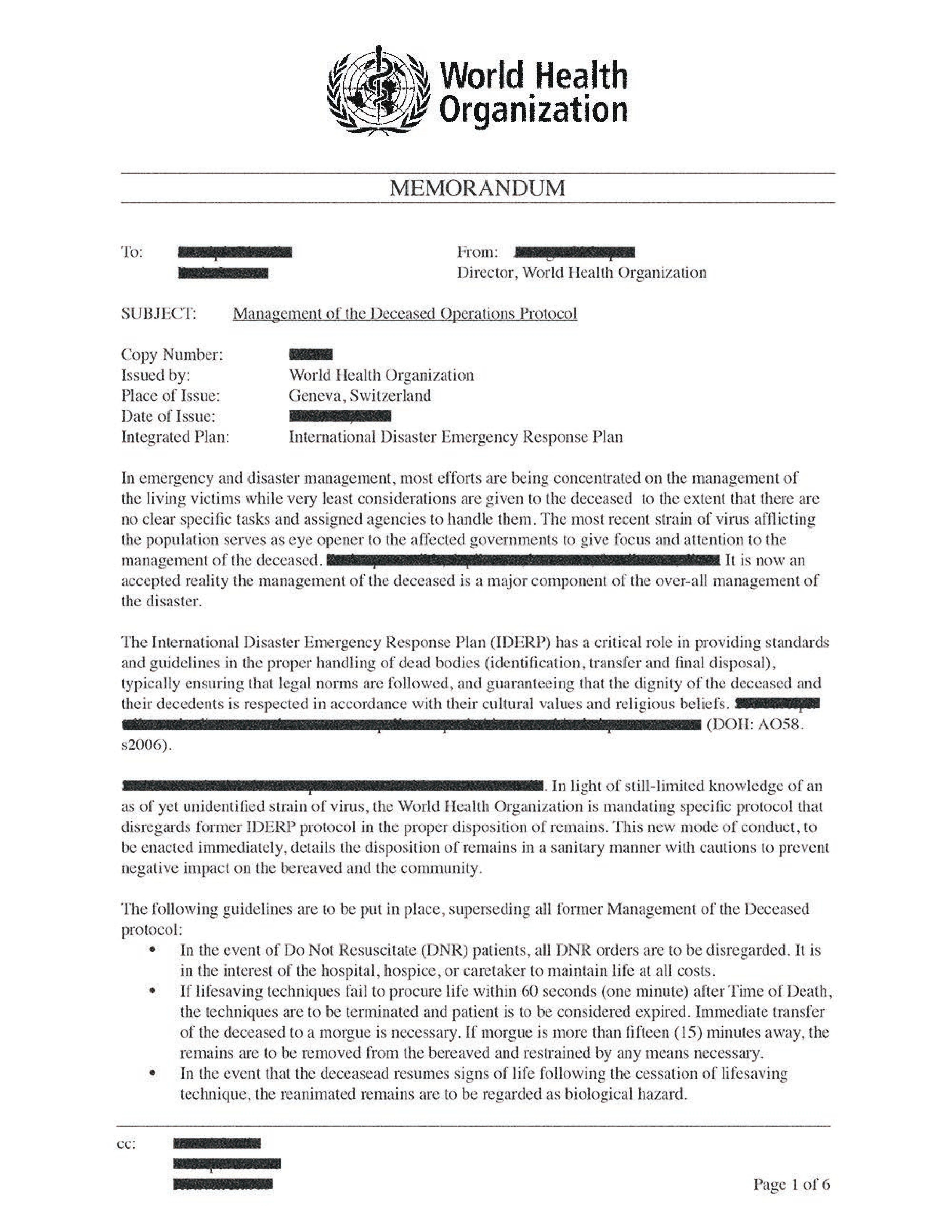

The MEMO issued by WHO
- In an instance where a patient has a Do Not Resuscitate Form (DNR), the DNR is to be ignored. It is in the best interest of the medical staff to keep the patient alive.
- If, within a minute of death, all efforts to revive the patient fail, life saving techniques are to cease and the patient is to be considered dead. The body is to be moved to the morgue. If the morgue is more than fifteen minutes away, the body is to be restrained.
- If the deceased regains signs of life AFTER life saving techniques have ceased, the body is to be considered a biohazard and disposed of.
Following Operation Cobalt in the United States and the collapse of society, the WHO has likely ceased to exist as a result of the disbanding of the United Nations.
Wildfire Memorandum
To: [REDACTED]
FROM: [REDACTED] Director, World Health Organization
SUBJECT: Management of the Deceased Operations Protocol
Copy Number: [REDACTED] Issued by: World Health Organization Place of Issue: Geneva, Switzerland Date of Issue: [REDACTED] Integrated Plan: International Disaster Emergency Response Plan
In emergency and disaster management, most efforts are being concentrated on the management of the living victims wile very least considerations are given to the deceased to the extent that there are no clear specific tasks and assigned agencies to handle them. The most recent strain of virus afflicting the population serves as an eye opener to the affected governments to give focus and attention to the management of the deceased. [REDACTED]. It is now an accepted reality the management of the deceased is a major component of the over-all management of the disaster.
The International Disaster Emergency Response Plan (IDERP) has a critical role in providing standards and guidelines in the proper handling of dead bodies (identification, transfer and final disposal), typically ensuring that legal norms are followed, and guaranteeing that the dignity of the deceased and their decedents is respected in accordance with their cultural values and religious beliefs. [REDACTED] (DOH: AO58. s2006).
[REDACTED]. In light of still-limited knowledge of an as of yet unidentified strain of virus, the World Health Organization is mandating specific protocol that disregards former IDERP protocol in the proper disposition of remains. This new mode of conduct, to be enacted immediately, details the disposition of remains in a sanitary manner with cautions to prevent negative impact on the bereaved and the community.
The following guidelines are to be put in place, superseding all former Management of the Deceased protocol:
- In the event of Do Not Resuscitate (DNR) patients, all DNR orders are to be disregarded. It is in the interest of the hospital, hospice, or caretaker to maintain life at all costs.
- If lifesaving techniques fail to procure life within 60 seconds (one minute) after Time of Death, the techniques are to be terminated and patient is to be considered expired. Immediate transfer of the deceased to a morgue is necessary. If morgue is more than fifteen (15) minutes away, the remains are to be removed from the bereaved and restrained by any means necessary.
- In the event that the deceased resumes signs of life following the cessation of lifesaving technique, the reanimated remains are to be regarded as biological hazard.
cc: [REDACTED]
[REDACTED]
[REDACTED]
Trivia
- The issuing of the WHO memo predates both the beginning of season one of both The Walking Dead and Fear the Walking Dead, and also public knowledge of the 'walker' epidemic. It can be assumed, therefore, that when Dr. Jenner is talking about the length of time that the epidemic has been spreading, considering that he is counting from the first 'patient' the CDC is aware of, it is several days/weeks before 'day zero' in either show.
Organizations (Fear)
|
|---|
| World Health Organization • California Highway Patrol • Los Angeles Police Department • Los Angeles Fire Department • U.S. Military • California National Guard • U.S. Border Patrol • Mexican Military • JLS National Bank • Latham Police Department • North Atlantic Treaty Organization |